The discovery of a purple mushroom poisonous variety in the wild presents a genuine danger that every forager and hiker must immediately understand, This specific fungal group contains potent toxins that can cause severe liver damage or even fatal outcomes within hours of accidental ingestion, Recognizing these threats allows outdoor enthusiasts to avoid life-threatening mistakes during their nature explorations.
Therefore, this expert article will systematically cover the critical identification markers, toxicological effects, and essential first-aid measures associated with these dangerous organisms.
Are Purple Mushrooms Poisonous?
The simple answer is: it depends entirely on the species, While many wild purple mushrooms are toxic, some are perfectly safe and even prized for their flavor.
When evaluating purple mushroom toxicity, you cannot rely on color alone, Several deadly look-alikes share similar hue profiles with safe edibles, The term purple mushroom poisonous is often misapplied to harmless species like the Wood Blewit, which is edible but frequently confused with the deadly Webcaps.
To navigate this risk, always cross-reference cap shape, gill attachment, spore print color, and habitat, Never taste a raw specimen to test its edibility.
Common Purple Mushroom Species
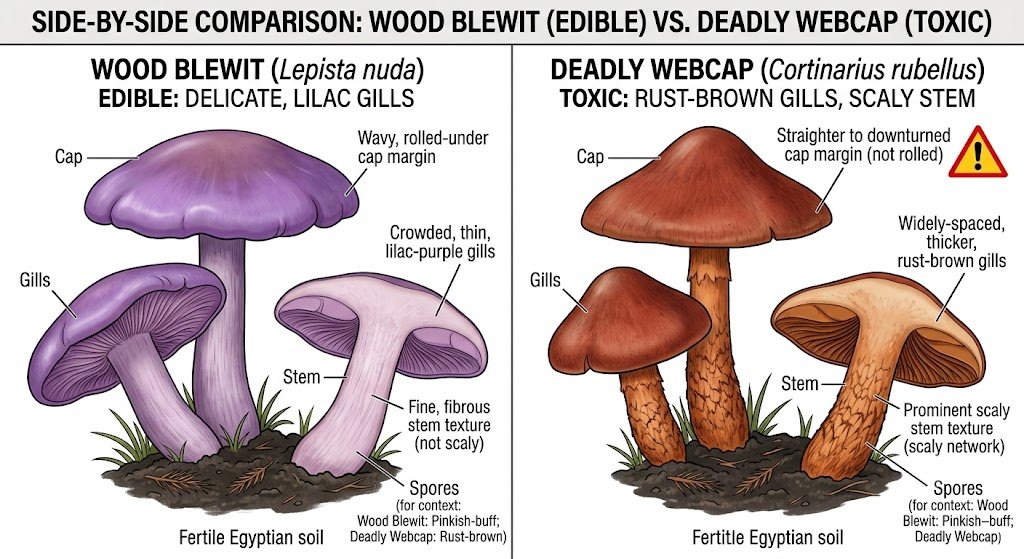
Here are the most frequently encountered purple mushrooms in forests and fields, listed in order of toxicity risk.
- Deadly Webcap (Cortinarius rubellus) – Contains orellanine, a toxin causing irreversible kidney failure, Color ranges from lilac to deep violet with a rusty-brown spore print.
- Amethyst Deceiver (Laccaria amethystina) – Small, edible but often mistaken for toxic species, Loses purple color with age and becomes tan.
- Wood Blewit (Clitocybe nuda) – Edible after cooking, with a pale lavender cap and a pinkish spore print, Commonly foraged in Europe and North America.
- Purple Jellydisc (Ascocoryne sarcoides) – Non-toxic but not palatable, Grows on dead wood and looks like purple gelatinous discs.
- Indigo Milk Cap (Lactarius indigo) – Edible with a blue-violet cap that bleeds blue latex when cut, Highly sought after for its color.
How to Identify Purple Mushrooms
Identifying wild purple mushrooms requires more than just noting the color; examine four key features to avoid misidentification.
Purple mushroom identification relies on checking the cap margin (smooth vs, grooved), gill attachment (free vs, decurrent), stem bulb and ring, and spore print color, Wild purple mushrooms like the Amethyst Deceiver have a thin, translucent cap, whereas the Deadly Webcap has a thick, fibrous stem with a skirt-like Cortina ring, Cross-reference your findings with a reliable field guide or expert mycologist before consuming any sample.
Poisonous Purple Mushrooms to Watch For
This section lists the most dangerous toxic purple mushrooms you may encounter, along with their specific risks.
| Species | Toxin | Onset Time | Primary Danger |
|---|---|---|---|
| Deadly Webcap (Cortinarius rubellus) | Orellanine | 2–14 days | Kidney failure |
| Conifer Webcap (Cortinarius orellanus) | Orellanine | 3–17 days | Permanent renal damage |
| Purple Brown Webcap (Cortinarius evernius) | Possible orellanine | Variable | Suspect — avoid all |
All three listed species belong to the Cortinariaceae family, which accounts for the vast majority of fatal purple mushroom poisoning cases worldwide, Their toxicity is delayed, making early diagnosis difficult.
Edible vs Toxic Purple Mushrooms
Distinguishing between edible purple mushrooms and dangerous look-alikes is a matter of examining three key details.
- Gill color and attachment: Edible Wood Blewits have pinkish, free gills, while toxic Webcaps have rusty-brown, attached gills that often have a web-like veil.
- Stem texture: Purple mushrooms safe to eat like the Blewit have a smooth, bulbous stem, whereas poisonous varieties show a fibrous or scaly stem with a distinct ring.
- Spore print: Pink or white print = generally edible (but confirm separately), Brown or rusty print = toxic, Never rely solely on color.
If you experience purple mushroom poisoning symptoms — such as nausea, vomiting, diarrhea, or unusual fatigue — seek emergency medical help immediately, Symptoms from orellanine poisoning can appear days later, so do not delay treatment even if you feel fine initially.
Symptoms of Purple Mushroom Poisoning
Recognizing poisoning symptoms early can save your life, especially when dealing with delayed-acting toxins like orellanine.
For purple mushroom poisoning, symptoms fall into two phases, Early phase (first 24 hours): nausea, vomiting, abdominal cramps, and diarrhea, Delayed phase (2–17 days): extreme thirst, reduced urination, lower back pain, and severe fatigue — indicative of progressing kidney failure, If you suspect you consumed a poisonous purple mushroom, do not wait for symptoms to worsen, Seek medical attention immediately, even if you feel well, A blood creatinine test is the only reliable way to confirm renal involvement.
What to Do If You Eat a Purple Mushroom
Take immediate, decisive action if you or someone else ingests an unknown purple mushroom — do not wait for symptoms to appear.
- Call poison control or emergency services (911 in USA) right away, Do not induce vomiting unless explicitly instructed by a medical professional.
- Save a sample of the mushroom, Place a whole uncooked specimen in a paper bag or wax paper — not plastic, A mycologist may need it for identification.
- Photograph the mushroom in situ, Capture the cap, gills, stem, and surrounding habitat, This helps experts confirm purple mushroom identification even if the sample is damaged.
- Drink water only if thirsty, Avoid alcohol, which can worsen dehydration and mask neurological symptoms.
- Monitor urine output closely, Reduced urine after 24 hours is a red flag for orellanine toxicity, Report any change to your healthcare provider.
How to Avoid Misidentifying Wild Mushrooms
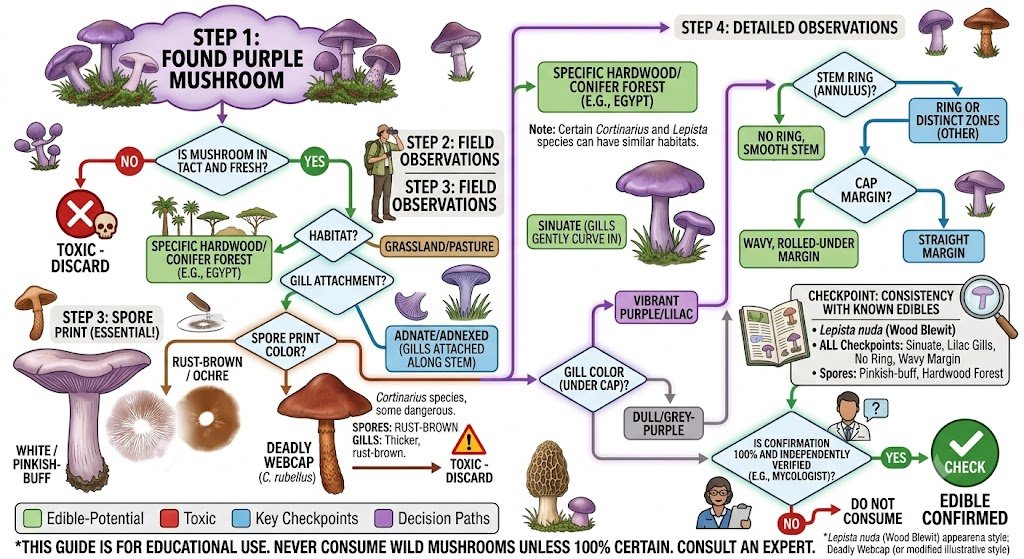
Reliable purple mushroom identification demands a systematic approach — trusting your eyes alone can be fatal.
Avoid misidentification by following this three-step cross-check method,
Step 1 — Spore print: A rusty-brown print eliminates all edible candidates; discard immediately,
Step 2 — Gill attachment: Decurrent (running down the stem) or notched gills often point to edible purple mushrooms like Blewits; free or adnexed gills require extra caution,
Step 3 — Habitat and season: Toxic purple mushrooms in the Cortinarius family typically fruit under conifers in late summer to autumn, Purple mushrooms safe to eat like Indigo Milk Cap grow near oaks and pines and bleed blue latex when cut — a unique, confirmable trait, Never rely on a single characteristic; always verify at least three features against a trusted field guide.
Safe Mushroom Foraging Tips
Foraging for wild purple mushrooms can be rewarding, but safety must come before curiosity or hunger.
| Foraging Rule | Why It Matters | Best Practice |
|---|---|---|
| Never eat raw specimens | Cooking breaks down some toxins but not all (orellanine is heat-stable) | Always cook thoroughly; boil and discard water for extra caution |
| Use a local field guide | Regional variations exist; online photos may be misleading | Carry a waterproof guide specific to your area |
| Forage with an expert | First-hand mentorship reduces chance of fatal purple mushroom poisonous mix-ups | Join a local mycological society or take a guided walk |
| Avoid young or old mushrooms | Immature caps lack key features; old ones decompose and hide toxins | Only harvest mature, intact specimens with full gill exposure |
Purple mushroom toxicity can persist even after cooking for some species, The Deadly Webcap’s orellanine remains active at 100°C, When in doubt, do not eat it, A single cap of a toxic poisonous purple mushroom can be enough to cause permanent kidney damage.
Frequently Asked Questions About Purple Poisonous Mushrooms
Here are answers to the most common questions regarding purple mushroom safety and toxicity.
Answer: No, Even a minuscule amount of orellanine can cause kidney damage over time, Moreover, some toxic mushrooms taste pleasant and mild, Never taste-test a mushroom to determine edibility — use spore prints and expert identification instead.
Answer: No, The Amethyst Deceiver (Laccaria amethystina) is bright purple and edible after cooking, while the Wood Blewit (Clitocybe nuda) is lavender and safe, However, many bright purple Cortinarius species are deadly, Color alone is not a reliable indicator of purple mushroom toxicity.
Answer: Initial symptoms include nausea, vomiting, and diarrhea within 6–24 hours, If orellanine is involved, these early signs may be mild or absent, followed by delayed kidney failure symptoms (thirst, low urine output) days later, Always consult a doctor if you suspect ingestion.
Answer: Some edible species like Wood Blewit can cause mild gastrointestinal upset if eaten raw, Always cook purple mushrooms safe to eat thoroughly to neutralize potential irritants and improve digestibility, Never assume a species is safe raw just because it is edible cooked.
Understanding the dangers associated with the purple mushroom poisonous varieties is absolutely essential for anyone who spends time foraging or hiking in natural environments, The vivid coloration of these fungi often acts as a natural warning signal that should never be ignored by even experienced mushroom enthusiasts, Accurate identification requires careful examination of cap shape, gill structure, stem features, and spore print color rather than relying solely on the mushroom’s purple hue,
Immediate medical attention must be sought if any symptoms such as nausea, vomiting, abdominal pain, or neurological disturbances develop after potential exposure to these toxic organisms, Proper safety measures include never consuming wild mushrooms without expert verification and always carrying a field guide written by certified mycologists for reference.
The best protection against poisoning remains thorough education about local toxic species combined with a healthy respect for the unpredictable nature of fungal biology in diverse ecosystems.