

Artificial general intelligence represents the most profound technological frontier humanity has ever encountered, promising machines that can learn and reason across any domain like a human mind. Understanding this transformative concept is crucial for anyone seeking to navigate the impending shifts in society, economy, and daily life. The pursuit of artificial general intelligence moves beyond narrow task automation to create truly adaptable systems capable of independent thought and creativity. This article will explore the essential breakthroughs, current challenges, and practical implications shaping this revolutionary field.
What Is Artificial General Intelligence?

Artificial general intelligence refers to a machine’s ability to understand, learn, and apply knowledge across any domain, matching human-level cognitive flexibility.
Unlike narrow AI systems that excel only at specific tasks (like playing chess or recommending movies), general artificial intelligence can transfer knowledge between domains—reasoning, planning, and adapting in real time. For example, an AGI could learn to cook a new recipe, then apply that logic to solve a physics problem, without being explicitly reprogrammed. This ability to perform human level ai functions across diverse scenarios is what makes agi such a transformative concept.
Artificial General Intelligence vs Narrow AI
This comparison highlights why agi is fundamentally different from the AI tools we use today.
| Aspect | Artificial General Intelligence (AGI) | Narrow AI |
|---|---|---|
| Scope | Performs any intellectual task a human can | Excels at one specific task (e.g., facial recognition) |
| Learning | Learns from few examples; transfers knowledge | Requires massive datasets; no transfer learning |
| Adaptability | Adapts to new, unseen situations autonomously | Fails outside training parameters |
| Examples | Hypothetical AGI systems (none exist yet) | ChatGPT, Siri, Tesla Autopilot |
Understanding what is agi vs narrow AI clarifies why agi remains theoretical—current systems lack the flexible reasoning needed for artificial general intelligence meaning true general intelligence.
Artificial General Intelligence vs Strong AI
These terms are often used interchangeably, but subtle differences exist.
- Origin of Terms: Strong AI was coined in philosophy to describe a machine that can actually think and have consciousness, not just simulate it. AGI emerged from computer science, focusing on functional capabilities—like passing the Turing test across all domains.
- Philosophical vs Technical: Strong AI includes subjective experience (qualia), while advanced artificial intelligence in the AGI sense prioritizes performance over consciousness. Most researchers agree that agi does not necessarily imply sentience.
- Current Status: Both remain theoretical. However, strong ai is often seen as a subset or extension of AGI—a machine that not only acts intelligently but also possesses inner awareness.
- Practical Implications: For developers, agi is about achieving human-level task performance. For ethicists, strong AI raises questions about rights and moral status. Debates around artificial superintelligence often build on these distinctions.
Is Synthetic Intelligence the Same as Artificial General Intelligence?
No, synthetic intelligence is a broader term that includes AGI but also covers non-biological intelligence forms.
Synthetic intelligence (SI) refers to any intelligence created artificially—whether it is narrow, general, or superintelligent. Meanwhile, general artificial intelligence specifically denotes a machine with cognitive abilities equal to a human across all tasks. SI can include things like swarm intelligence in robotics or hybrid systems that combine biological and digital components. So while all AGI is synthetic intelligence, not all synthetic intelligence meets the criteria of human level ai. Understanding this nuance helps clarify agi examples and avoid conflating terms in research.
How Would Artificial General Intelligence Work?
No single blueprint exists, but leading theories propose integrated architectures combining multiple AI techniques.
Many researchers believe that replicating the human brain’s structure—using spiking neural networks and synaptic plasticity—is a promising path. Others advocate for ‘symbolic AI’ combined with deep learning to handle both logic and pattern recognition. A key challenge is achieving strong ai autonomy without unintended behaviors. The future of agi likely involves hybrid models that learn from minimal data, reason causally, and continuously update their world models—similar to how a child explores and learns.
Examples of Artificial General Intelligence Concepts
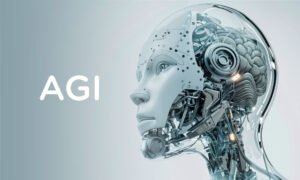
While no fully functional AGI exists, several hypothetical and early-stage concepts illustrate the vision.
- • The AGI Child: A system that starts with basic knowledge (like a toddler) and learns through interaction with the world, building understanding over years. Companies like DeepMind have experimented with ‘agent’ models that generalize across games.
- • The Universal Problem Solver: A theoretical framework where any input problem—from diagnosing diseases to composing music—is broken down into subgoals and solved using logical inference plus learned heuristics. This is a classic agi example from AI research.
- • Self-Improving AGI: A machine that can rewrite its own code to become more efficient, leading to a ‘takeoff’ toward artificial superintelligence. This concept is central to discussions about safety and control.
- • The Synthetic Friend: An AGI designed to understand human emotions, context, and culture, offering companionship and personalized education—moving beyond today’s chatbots into advanced artificial intelligence that truly empathizes.
These concepts remain aspirational but guide research funding and public imagination, shaping what we expect from agi technology in the coming decades.
Why Artificial General Intelligence Matters
AGI could revolutionize every sector, from healthcare to climate science, by offering human-like reasoning at machine speed.
- Global Problem Solving: A single AGI could simultaneously tackle complex issues like disease modeling, renewable energy optimization, and poverty alleviation—tasks that today require armies of specialists. This capacity for cross-domain innovation defines agi technology.
- Scientific Acceleration: By autonomously designing experiments, analyzing results, and forming new hypotheses, AGI could compress centuries of research into decades. This is the core promise of strong ai in discovery.
- Economic Transformation: McKinsey estimates that human level ai could add $13 trillion to global GDP by 2030, reshaping industries from logistics to law. AGI would unlock entirely new markets and job categories.
- Human Augmentation: Rather than replacing us, AGI could act as a cognitive partner—helping artists, engineers, and educators reach new creative heights. This synergy between humans and advanced artificial intelligence defines the positive future of agi.
These four dimensions show why understanding artificial general intelligence meaning is not just academic—it’s essential for preparing our societies.
Benefits of Artificial General Intelligence
From personalized education to planetary defense, AGI offers transformative advantages that span every aspect of life.
| Domain | Current Limitation | AGI Benefit |
|---|---|---|
| Healthcare | Narrow AI can read X-rays but cannot diagnose rare conditions | AGI integrates symptoms, history, and research to provide general artificial intelligence diagnosis |
| Education | One-size-fits-all curriculum | AGI adapts teaching style in real time to each student’s cognitive profile |
| Environment | Static climate models | AGI predicts and suggests interventions for agi examples like carbon capture optimization |
| Space Exploration | Slow human decision-making | Autonomous AGI manages deep-space missions beyond communication delays |
These agi examples show how what is agi translates into real-world value—moving beyond narrow tools to genuine problem-solving partners.
Risks and Challenges of Artificial General Intelligence
Despite its transformative potential, Artificial General Intelligence (AGI) also introduces significant risks that researchers, policymakers, and technology leaders must address before widespread deployment. Key challenges include value alignment—ensuring that AGI systems consistently pursue goals that reflect human intentions and ethical principles—along with maintaining reliable control over increasingly autonomous systems. There are also concerns about security, misuse, economic disruption, and the possibility that highly advanced AI could act in ways that are difficult to predict or manage. The future development of AGI will depend not only on advancing capabilities but also on creating robust safety measures, governance frameworks, and oversight mechanisms that keep those capabilities aligned with human interests.
When Could Artificial General Intelligence Become Real?

Predictions vary widely, but most experts agree AGI is decades away—not imminent, but plausible within our lifetimes.
- • 2025–2030 (Early Signs): Narrow AI gains broader reasoning via hybrid models. Systems like GPT-5 may display limited human level ai in specific reasoning benchmarks, but still lack true generalization.
- • 2030–2050 (Medium Confidence): Many researchers (50% in the AI Impacts survey) believe AGI will emerge in this window. Breakthroughs in neuromorphic computing and symbolic reasoning could produce the first general artificial intelligence prototypes.
- • 2050–2100 (High Uncertainty): If progress stalls, AGI may arrive later, requiring new physics or computing paradigms. Conversely, rapid self-improvement could lead to artificial superintelligence shortly after AGI.
- • Never? Some philosophers argue that machine consciousness or true generalization may be impossible. This debate keeps artificial general intelligence meaning both a scientific and philosophical frontier.
While no one knows exactly what is agi’s timeline, the best preparation is to learn about agi technology now—so you can shape, not just react to, this transformation.
FAQs About Artificial General Intelligence
Quick answers to the most common questions about strong ai and its implications.
What is the difference between AGI and artificial superintelligence?
AGI matches human cognitive ability across all tasks. Artificial superintelligence (ASI) surpasses human intelligence in every domain—creativity, social skills, scientific discovery—by a significant margin. ASI would likely emerge shortly after AGI, as even a modestly smarter system could rapidly self-improve. This escalation is why understanding agi examples and agi vs ai distinctions are critical for safety planning.
Does Artificial General Intelligence exist today?
No. Current AI systems are specialized for specific tasks and do not possess human-level intelligence across all domains.
How could AGI change everyday life?
AGI could automate complex work, improve healthcare and education, and assist with a wide range of daily tasks.
When will Artificial General Intelligence be developed?
No one knows for sure. Estimates range from the coming decades to much later, depending on future technological breakthroughs.
The rapid acceleration of breakthroughs in fields like natural language processing and reinforcement learning is steadily pushing artificial general intelligence closer to reality, yet researchers still grapple with fundamental challenges of reasoning and generalization. Artificial general intelligence promises to revolutionize industries from healthcare to climate science by enabling machines to perform any intellectual task a human can, but this profound capability also demands rigorous ethical safeguards to prevent misuse and societal disruption. Understanding these ten transformative breakthroughs is essential for anyone seeking to navigate the profound changes that artificial general intelligence will bring to our daily lives.
Despite remarkable progress in multimodal learning and self-supervised architectures, the path to artificial general intelligence remains fraught with technical hurdles, including the need for genuine common sense reasoning and robust safety alignment mechanisms. The breakthroughs highlighted in this article demonstrate that artificial general intelligence is not merely a distant theoretical concept but an emerging reality being shaped by concrete innovations in transformer models, neural-symbolic integration, and energy-efficient computing. Stakeholders across technology, policy, and education must collaborate now to ensure that artificial general intelligence develops in a way that benefits humanity broadly rather than concentrating power and exacerbating inequalities.
Ultimately, the journey toward artificial general intelligence represents one of the most significant technological endeavors in human history, requiring unprecedented cooperation between computer scientists, neuroscientists, and policymakers. The ten breakthroughs discussed here offer a roadmap for understanding how artificial general intelligence will transform our future, from autonomous scientific discovery to personalized education, but they also underscore the urgent need for proactive governance frameworks. As artificial general intelligence capabilities continue to evolve rapidly, our collective responsibility is to steer this powerful technology toward outcomes that enhance human flourishing while carefully mitigating existential risks.